
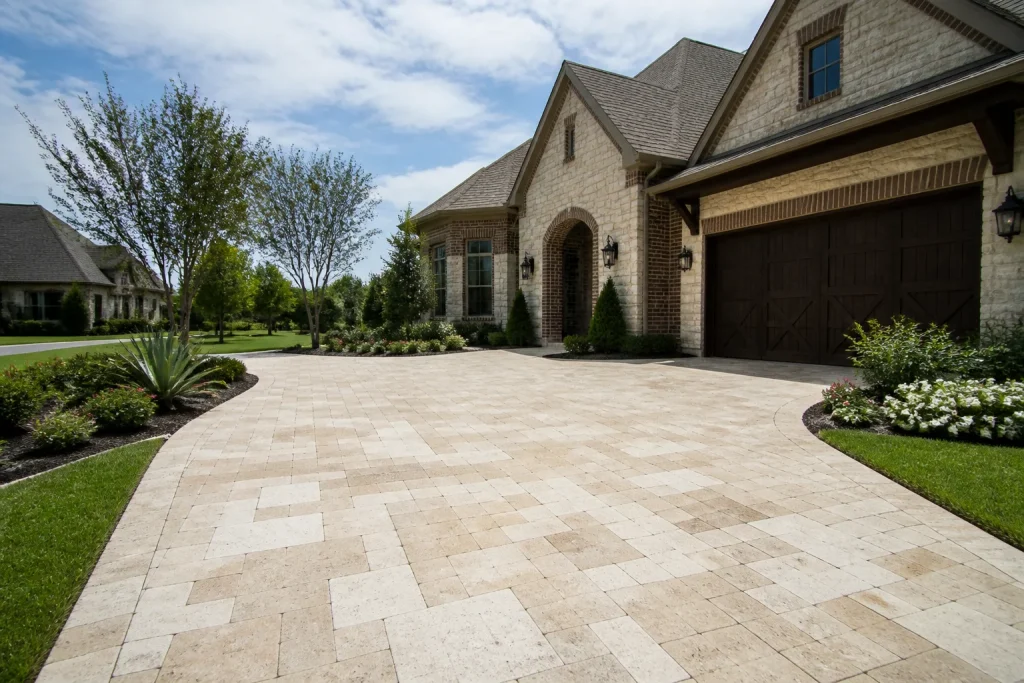
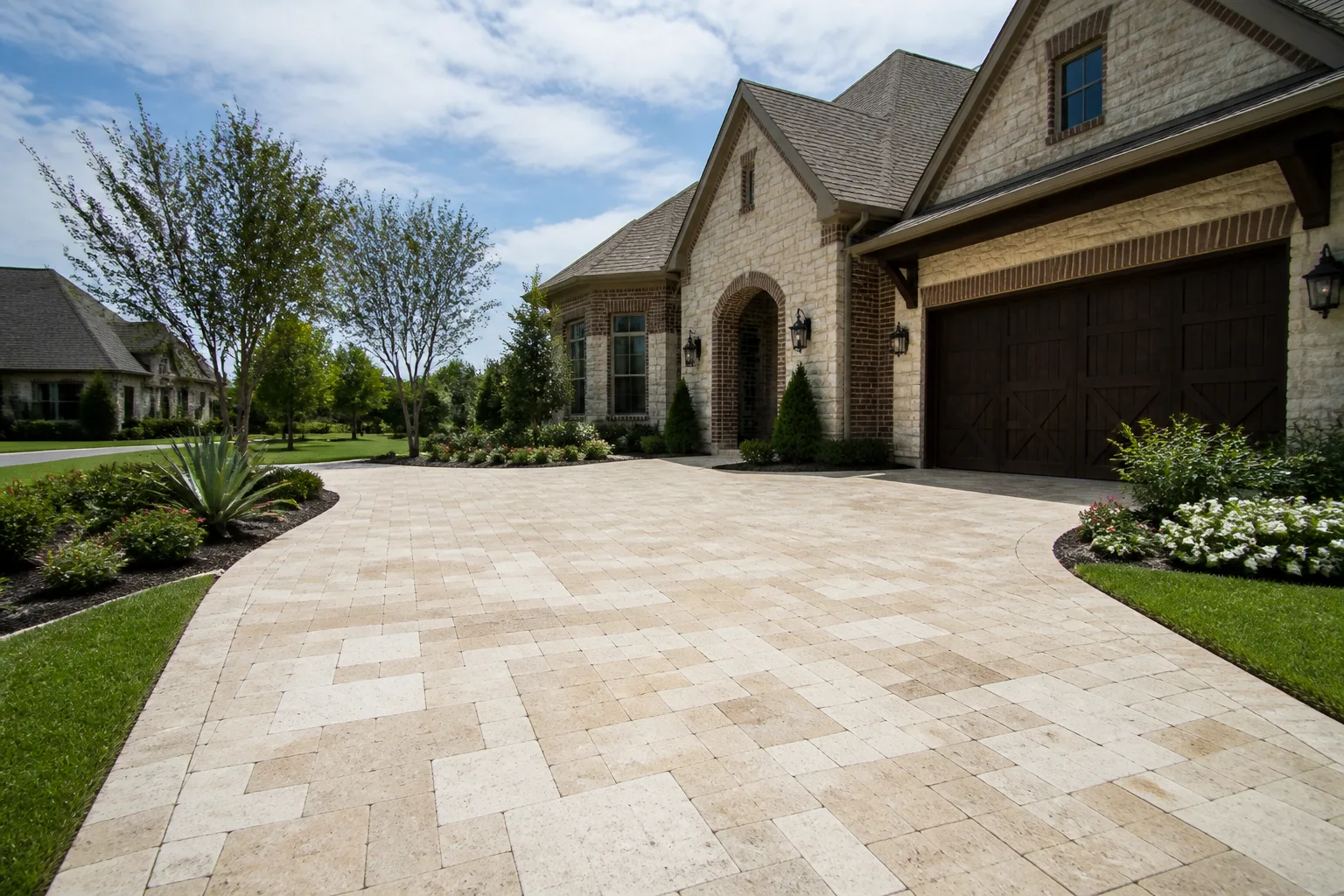
Blanco Driveway & Pavers in Allen: A Homeowner’s Guide
Blanco pavers get sold in Allen as a premium upgrade, and they are. But roughly three out of five Blanco installs we’re called out to inspect fail inside five years, and the product is almost never the reason. The culprit is base prep on expansive North Texas clay. Blanco’s density and thickness are real advantages, and they mean nothing if the slab underneath moves. If you’d rather have someone who knows the difference walk your driveway, call (888) 343-9048.
Key Takeaways
- Blanco pavers are dense and strong, but Allen’s clay soil moves seasonally and will crack a thin base no matter how good the stone is.
- Most Blanco lines sold in Allen are rated for patios, not driveways. The product spec sheet tells you which is which.
- Joint sand matters more with Blanco than with most brands because of how tight the units fit and how hot Allen gets in July and August.
- A correct base in Allen runs deeper than most bids show, gets compacted in lifts, and slopes away from the slab.
- Five questions near the bottom of this guide will tell you in ten minutes whether a contractor actually knows the product.
Why do Blanco pavers fail early on Allen driveways?
Allen sits on the Blackland Prairie belt, and that means expansive clay. That clay swells after a wet spring and shrinks hard in a dry August. A driveway is a rigid surface sitting on a moving one, so the base has to absorb that movement without telegraphing it up into the pavers. When it doesn’t, you get the classic failure pattern: hairline cracks radiating from the corners, a slight dip where the car parks, and joints that start pumping sand after rain.
Blanco units are denser and heavier than a lot of what’s stocked around Collin County, which is genuinely good for load spreading. Density helps distribute a vehicle’s weight across the surface. It does nothing for a base that was compacted in one thick pass instead of proper lifts, or a subgrade that was never proof-rolled before the bedding layer went down.
We pulled a Blanco driveway out of a garage over in Twin Creeks last spring where the pavers themselves were flawless. Every single one. The base was four inches of uncompacted fill, and the whole field had settled almost an inch at the apron. That’s a base failure wearing a premium product’s clothes.
Which Blanco lines are actually rated for driveway load?
This is where Allen homeowners get upsold the wrong product more than anywhere else. Blanco makes pavers for both pedestrian and vehicular use, and the two are not interchangeable. A patio-rated unit will look identical on a sample board and fail under a truck.
What to look for on the spec sheet:
- Compressive strength. Driveway-rated units are typically specified well above what a patio paver needs. Ask for the number in writing, not a verbal “yeah, it’s rated for cars.”
- Thickness. Vehicular applications call for a thicker unit than pedestrian ones. A thin paver on a driveway is a warranty claim waiting to happen.
- Water absorption. Lower absorption matters more here than in cooler climates because of our freeze-thaw swings. Allen does get hard freezes, and saturated pavers that freeze will spall.
- Application listing. The manufacturer publishes which lines are approved for driveways. Ask to see that page, not a brochure photo.
If a bid lists a Blanco product without a thickness or an application rating, that’s your first red flag. A contractor who knows the product will hand you the spec sheet before you ask. One who’s guessing will change the subject to color selection.
Why joint sand choice matters more with Blanco pavers in Allen heat
Blanco units are cut tight, and tight joints are a good thing until the sand between them starts migrating. In Allen’s summer heat, ordinary mason sand dries out, blows out, and washes away with the first big rain. Once the joints open up, water gets under the pavers, the base softens, and the field starts to shift. That’s the beginning of the end.
Polymeric sand is the standard answer, and for Blanco it’s the right one, but the grade matters. You want a joint sand rated for vehicular traffic and for the temperature range we actually get here. Cheap polymeric sand that cures too fast in 100-degree heat will crack along the joint line within a season.
Two more things specific to Blanco and Allen:
- Because the joints are tight, sand has to be worked in properly and watered in per the manufacturer’s cure instructions. Rushing the cure in August is how you get a crumbly joint by October.
- Sealing is optional but worth discussing. In our experience, a breathable sealer applied correctly after the cure helps the sand stay put through Allen’s spring storms, and it keeps the color from fading under the UV load we get here.
If a bid doesn’t mention joint sand by name, ask what they’re using and why. “Standard sand” is not an answer for a Blanco driveway in this climate zone.
What a correctly installed Blanco base looks like in Allen
Here’s the part most bids skip, so here’s what you should actually see on a Blanco driveway in Allen’s climate zone. Depth, compaction, and drainage are the three legs of the stool, and losing any one of them sinks the job.
- Excavation to the right depth. The base plus bedding layer plus paver thickness has to add up to a finished surface that sits correctly against your garage apron and the street. Cutting the base short to save a day is the most common shortcut we see.
- Geotextile separation fabric. On expansive clay, a separation layer between subgrade and base keeps fine clay particles from pumping up into the aggregate and turning it into mush over time. It’s an inexpensive step that’s easy to leave out.
- Compaction in lifts. Aggregate gets placed and compacted in layers, not dumped in one pile and hit once with a plate compactor. Each lift gets proof-rolled and tested for density before the next one goes down.
- Drainage slope. The finished surface needs to shed water away from the house and the slab, typically a gentle slope toward the street or a swale. Flat is not a grade, and a driveway that ponds at the apron will fail no matter what paver is on top.
- Edge restraint. A properly set edge keeps the field from spreading under load. This is a small detail that makes a large difference on a Blanco driveway over ten years.
None of this is exotic. It’s just a base built for soil that moves. Our technicians have up to 12 years of experience on exactly this kind of ground, and the difference between a base built this way and one built for speed shows up in year three, not year one.
Questions to ask any contractor bidding Blanco pavers in Allen
You don’t need to become a paver expert. You need to ask five questions and listen for specific answers. Vague answers are the tell.
- “Which Blanco line are you specifying, and what’s its driveway application rating?” They should name the line and the rating without checking their phone.
- “How deep is the base, and how many lifts?” A real answer includes a depth in inches and a compaction plan. “Plenty” is not an answer.
- “What joint sand are you using, and how are you curing it in summer heat?” You’re listening for a named polymeric sand and a cure process.
- “How are you handling the clay subgrade?” Look for separation fabric, proof-rolling, and a drainage plan. Bonus points if they mention how they’re tying into the existing grade at the garage.
- “What does the workmanship warranty cover, and how long is it?” Get the number in writing. Ours is the 730-Day Done Right Promise, and we put it on the contract in plain language.
“When to call a pro” on a driveway job is basically always. This isn’t a weekend project you can safely shortcut, and a failed base means paying twice. If a bidder can’t answer those five questions on the spot, call (888) 343-9048 and we’ll walk the driveway with you.
Related services in Allen
The same soil and heat that make Blanco tricky on a driveway affect your other exterior projects too. If we’re already out, homeowners often ask us to look at Driveway & Pavers in Allen and Fence Installation in Allen while we’re on site. For bigger plans, our Home Additions & ADU in Allen team handles the structural side, and you can start at the Groundwork Construction Co. of Allen home page.
The Bottom Line
Blanco pavers are a good product. They’re dense, they hold up to traffic, and on a correct base they’ll outlast the house. The failure stories in Allen almost always trace back to a base built for a patio on ground that moves, or a product line that was never rated for a car. Get the spec sheet, ask the five questions, and insist on a base built for expansive clay. That’s the whole game.
Our projects run on upfront pricing with no surprises, brand partners like Belgard and James Hardie across the exterior trades, and a written guarantee we actually stand behind. If you’re in Allen and want an honest read on a bid or a fresh estimate, we offer free estimates and design consults. Call (888) 343-9048.
Frequently Asked Questions
Most Blanco driveway installs in Allen land in the mid-to-high teens per square foot installed, with the price driven more by base depth and site access than by the paver itself. Spec-grade Blanco lines run higher than entry-level concrete pavers, and a correct base for clay soil adds cost that a cheap bid will simply omit. Call (888) 343-9048 for an exact quote, and estimates are free.
It shouldn’t. A real quote accounts for excavation, base depth, separation fabric, compaction, joint sand, and edge restraint before the first shovel hits. When a contractor discovers the subgrade needs more than expected, a well-written bid has already priced that in. Ask for the line items in writing, and hold the bidder to a fixed number. Call (888) 343-9048 to see what a line-item quote looks like.
A typical residential Blanco driveway in Allen takes several working days from excavation to final sand cure, with the cure extending a day or two past the last paver. Weather plays a role, especially during spring storms and the August heat. Call (888) 343-9048 to get a realistic schedule for your driveway.
Many Allen driveway replacements don’t require a permit, but any change to drainage, grade, or the connection at the curb may, and it’s worth confirming before work starts. We handle the permit question as part of the estimate so you’re not the one chasing the city. Call (888) 343-9048 to talk through your specific situation.
Written by the team at Groundwork Construction Co. of Allen.
Need Construction Help?
Call Groundwork Construction Co. of Allen - licensed & insured, here with fast after-hours help in Allen.
(888) 343-9048